Why international customers abandon checkout
 Stella Brown·November 19, 2026·8 min read
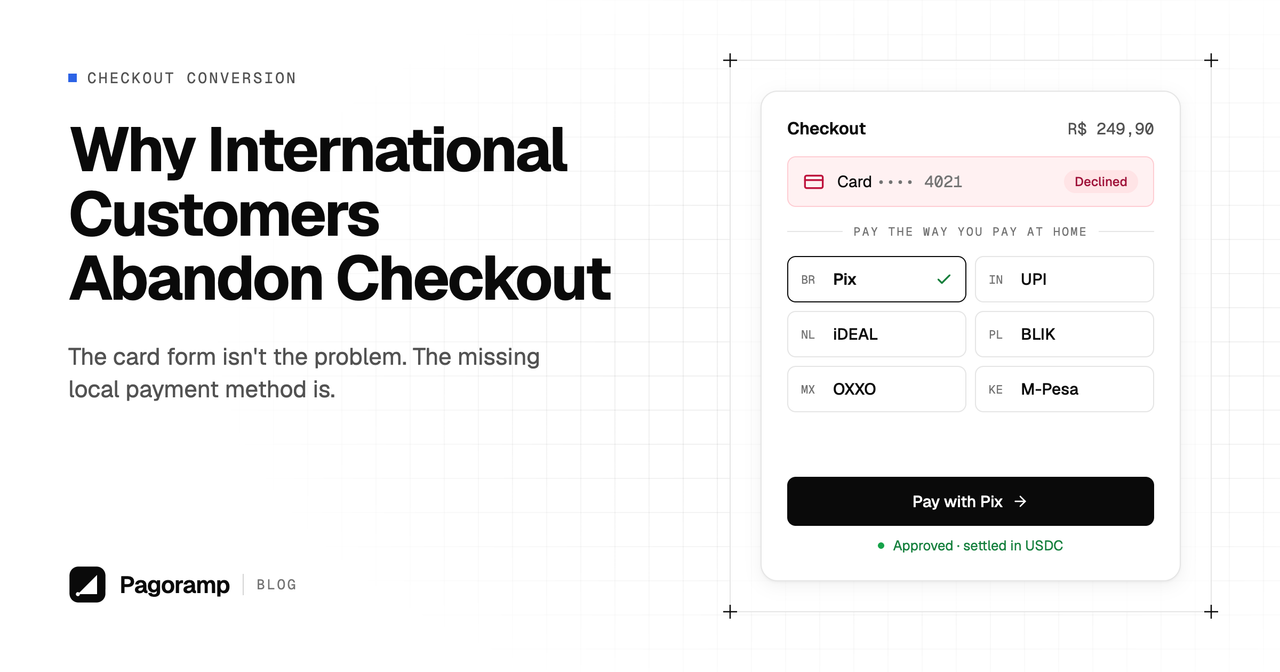
Baymard Institute puts the average online cart abandonment rate at 70.22%, averaged across 50 studies. In its latest survey of shoppers who left with real intent to buy, 10% said their card was declined and 9% said there weren’t enough payment methods. Those respondents were American, shopping mostly with domestic cards. For a customer in São Paulo, Mumbai or Nairobi buying from a business abroad, both numbers are a floor, not a ceiling.
International customers rarely abandon because your card form is badly designed. They abandon because the way they actually pay is not on the page, or because the card they try instead gets declined at the border. This guide covers the specific reasons international customers abandon checkout, how to tell which one is costing you, and what to fix first.
Why domestic benchmarks understate the problem
Most abandonment research, including Baymard’s cart abandonment statistics, surveys shoppers in card-first markets. In those markets a card form covers almost everyone, so “not enough payment methods” stays a single-digit reason.
Outside them, the picture changes. In 2025, digital wallets carried 56% of global e-commerce value, according to the Worldpay Global Payments Report 2026, while cards used directly accounted for about 30%. In Brazil, Pix alone took 42% of online spend. A Brazilian shopper who meets a card-only checkout is not missing a preference. They are missing the method they use for most purchases.
The five reasons international customers abandon checkout
1. Their local payment method is not there
This is the largest and most fixable cause. Customers expect to pay the way they pay at home:
- Real-time bank payments: Pix in Brazil, UPI in India, SPEI in Mexico, BLIK in Poland.
- Bank transfer and direct debit: iDEAL in the Netherlands, SEPA across Europe, bank transfer in Nigeria and Indonesia.
- Mobile money: M-Pesa in Kenya, MTN MoMo across West and Central Africa. No bank account needed.
- Cash vouchers: OXXO in Mexico, Boleto in Brazil, for customers who prefer to pay in cash.
If none of these appear, the customer has two options: dig out a card they rarely use online, or leave. Many leave.
2. The card they try instead is declined
When a customer does reach for a card, a cross-border payment is declined more often than a domestic one. The issuing bank sees a foreign merchant, a foreign acquirer and sometimes a foreign currency, and its fraud rules tighten. Merchants focused on cross-border sales report an average cross-border payment failure rate of 11%, according to PYMNTS Intelligence research with Nuvei, which estimated failed cross-border payments cost US merchants at least $3.8 billion in lost sales in 2023.
Some cards fail for simpler reasons. Many debit cards in emerging markets are not enabled for international online purchases by default. The customer only finds out at your checkout, and the error message from their bank rarely tells them why.
3. The total changes at the last step
Extra costs are the top abandonment reason in Baymard’s survey, cited by 40% of shoppers with intent to buy. For an international customer, the extra cost is often currency. A price shown in US dollars becomes a different number on their statement after conversion, and many card issuers add a foreign transaction fee on top. A customer who cannot work out what they will actually pay often does not pay.
4. Their bank adds a step they cannot complete
Card authentication such as 3-D Secure sends the customer to their bank to approve the payment. When it works, it is a few seconds. When the bank’s page fails to load, times out, or expects a code sent to a phone number the customer no longer uses, the payment dies there and you see an abandoned session, not a decline.
5. The checkout does not look like it was built for them
A checkout in a foreign language, priced in a foreign currency, with only card logos the customer does not recognise, reads as a risk. Showing the methods they know, such as Pix, UPI or M-Pesa, is itself a trust signal: it tells the customer this business expects them.
How to find out which reason is costing you
You do not need a survey. Your own checkout data answers most of this.
- Split abandonment by country. Pull 90 days of checkout sessions. Any market with abandonment well above your domestic rate is where to look first.
- Find where they stop. Drop-off before entering payment details points to a missing method or a price problem. Drop-off after submitting points to declines or authentication.
- Split card declines by card country. If foreign-issued cards decline far more often than domestic ones, retrying the card will not fix it. Offering a local method will.
- Check the decline codes. A cluster of generic “do not honor” responses from one country usually means issuer risk rules, not customer error.
- Compare currency display. If you show only one currency, test local pricing in your largest international market and compare completion.
What to fix first
Fix in the order your data points to, but for most businesses the sequence looks like this:
- Add the dominant local method in your largest international market. One method in one market, measured, beats ten methods launched at once.
- Show prices in local currency. Remove the conversion surprise before the customer reaches payment.
- Route cards so cross-border declines fall. Local acquiring and network tokens raise approval rates on foreign cards.
- Offer a fallback on decline. When a card fails, show the local alternatives right there, not an error and a blank form.
Which local methods to add, by market
Use this as a starting map. Your own traffic decides the order.
| Market | Methods to prioritise |
|---|---|
| Brazil | Pix, credit cards with instalments, Boleto |
| India | UPI, cards, net banking |
| Mexico | Cards, SPEI transfer, OXXO cash vouchers |
| Netherlands | iDEAL, cards, wallets |
| Poland | BLIK, bank transfer, cards |
| Germany | PayPal, SEPA direct debit, buy now, pay later |
| Kenya | M-Pesa, cards |
| Nigeria | Bank transfer, cards, USSD |
| Indonesia and the Philippines | Bank transfer to a virtual account, e-wallets such as GoPay and GCash |
The trade-off: chargebacks and refunds
Most bank push payments, including Pix, UPI and SEPA credit transfers, have no card-style chargeback. The customer approves the payment in their own banking app, and a refund is something you send rather than something taken from you. Some schemes have their own fraud-return processes, so exposure is lower, not zero. The practical effect: shifting volume to push payments can bring a high chargeback ratio down, and your refund policy carries more weight, so state it clearly.
How Pagoramp handles it
You accept cards, crypto and local payment methods through one checkout and one integration, so adding a market does not mean adding a contract, a reconciliation file and a payout schedule.
- Bank-transfer markets. Virtual accounts give each customer a local account number in 11 currencies, and incoming payments match automatically.
- Customers who prefer crypto. Crypto runs through the same integration as cards; here is how that works without a separate stack.
- Settlement. You choose how you get paid: settle in stablecoin, or pay out to your local bank account or mobile money. See how stablecoin settlement compares with traditional payouts.
- Onboarding. Most merchants are low or medium risk and go live instantly. High-risk verticals are approved too. Risk tier changes the rate and the rails, not the product.
Method coverage differs by country, so check the current list for the markets you sell into before you plan a rollout.
Frequently asked questions
What is a normal checkout abandonment rate for international customers?
There is no reliable global benchmark split by domestic and international buyers. Baymard’s 70.22% average is mostly drawn from card-first markets. The useful comparison is your own: international abandonment against your domestic rate, market by market.
Will adding more payment methods clutter my checkout?
Not if you show methods by location. A customer in Brazil needs Pix and cards, not iDEAL and BLIK. Show the three or four that matter where the customer is.
Why are foreign cards declined more often?
The issuing bank treats a payment to a foreign merchant as higher risk, so its fraud rules are stricter. Some cards, especially debit cards in emerging markets, are not enabled for international online use at all.
Should I price in local currency?
Usually, yes, in your largest international markets. It removes the conversion step that makes customers unsure of the final cost.
Do I still need cards if I add local methods?
Yes. Cards remain the main way to pay in the US and UK and a strong option almost everywhere. Local methods sit next to cards, not in place of them.
Do I need a local company to accept local methods?
If you integrate each method directly, often yes. A provider that collects on your behalf can remove that requirement. Check the terms for each country you plan to sell into.
Next step
Every market on a card-only checkout is revenue you are not collecting. Add the methods your international customers already use, through one integration, and choose how you settle.