What is a virtual account, and how do businesses use one to collect payments
 Stella Brown·November 19, 2026·9 min read
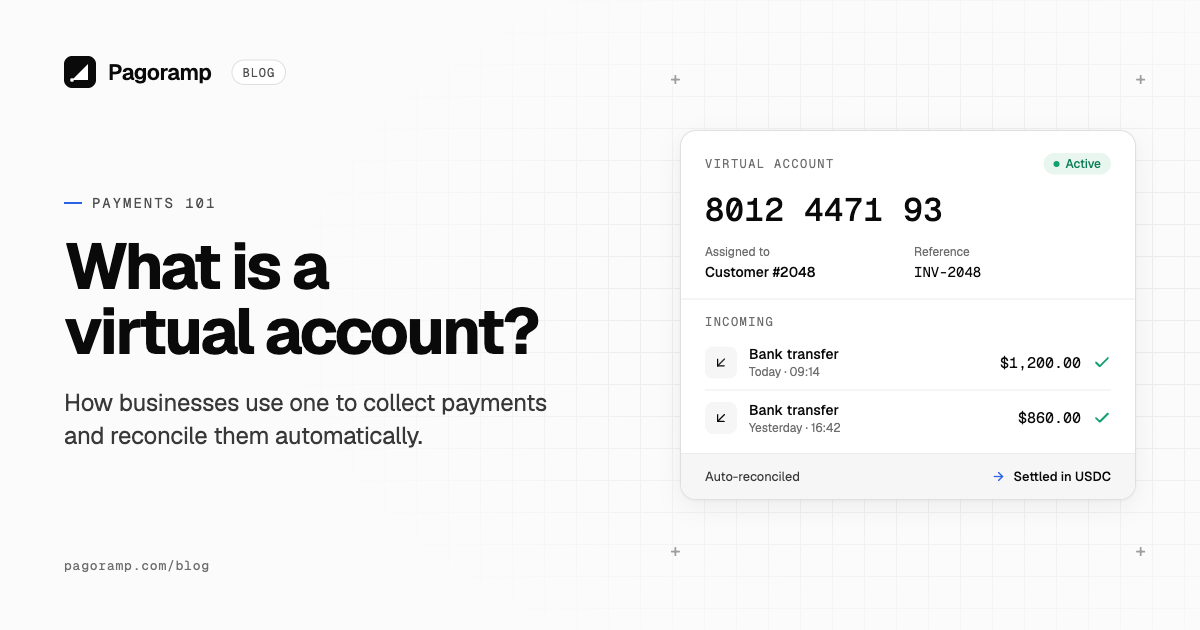
In a 2025 survey of 500 US finance decision-makers, 24% said manual, slow payment reconciliation was one of their biggest payment problems, and 71% said it was hard to see money moving across their bank accounts, according to Modern Treasury’s State of Payment Operations 2025 report, run with Harris Poll. Most of that work starts with one question: who sent this transfer?
A virtual account answers that question before the money arrives. This guide covers what a virtual account is, how it differs from a bank account and a virtual card, how businesses use one to collect payments, and what to check before you pick a provider.
What is a virtual account?
A virtual account is a unique account number that sits on top of a real account. Customers send money to it like any other bank account. The funds land in one underlying account, but the virtual number tells you exactly which customer, invoice or order the payment belongs to.
The key idea is one number per payer. Instead of asking every customer to send money to the same account and type a reference, you give each customer their own number. The number is the reference. Customers cannot forget it, mistype it or leave it out.
How a virtual account works
- You issue a number. Through a dashboard or an API, you create a virtual account for a customer in the currency they pay in.
- The customer pays by bank transfer. They send money from their own banking app, on the local rail they already use: ACH in the US, SEPA in Europe, Faster Payments in the UK, Pix in Brazil, SPEI in Mexico.
- The payment is matched. Because the number belongs to one customer, the payment is attributed to that customer automatically. No one has to read a bank statement.
- The funds settle. The money moves to your balance, and you decide where it goes next.
This is why treasury teams adopt them. In a Tietoevry survey on corporate cash management, 57% of respondents named better reconciliation as a reason for choosing a virtual account structure, as described in its piece on automating accounts receivable.
Virtual account vs. bank account vs. virtual card
The term gets used for three different things. If you searched for a “virtual account” after receiving a rewards card, you were looking at a card, not an account. Here is how they differ.
| Traditional bank account | Virtual account | Virtual card | |
|---|---|---|---|
| What it is | A standalone account that holds a balance | A unique number that routes payments into an underlying account | A card number for spending, with no physical card |
| Used to | Hold and move money | Receive money and identify who sent it | Pay for things online |
| Who opens it | The account holder, one at a time | The business, as many as it needs, often by API | A card issuer, for a cardholder |
| Matching payments | Manual, by reference | Automatic, by number | Not applicable |
A virtual account does not replace your business bank account. It sits in front of it and does the sorting.
Dedicated and one-time virtual accounts
Most providers offer two types, and many businesses use both.
- Dedicated accounts are permanent. The customer keeps the same number and can pay any amount, any number of times. They suit subscriptions, wallet top-ups, marketplaces and repeat B2B customers.
- One-time accounts are issued for a single payment. You set the expected amount and an expiry. If the customer sends a different amount, the payment is flagged for review instead of being credited automatically. They suit invoices and checkouts where the number should only work once.
How businesses use virtual accounts to collect payments
Invoicing and B2B payments
Business customers often pay several invoices in one transfer, or pay late with a reference that matches nothing. A one-time account per invoice ties each payment to the invoice it settles. A dedicated account per customer at least ties every payment to the right customer, so your team starts from the right ledger instead of a blank one.
Subscriptions, wallets and top-ups
If your customers fund a balance, whether that is a trading account, a payroll wallet or prepaid credit, a dedicated account lets them top up whenever they like. Each transfer credits the right balance without a support ticket asking where their money went.
Marketplaces and platforms
A platform that collects for many sellers can issue a number per seller or per buyer. Incoming funds are attributed at the moment they arrive, which makes splitting and paying out simpler to reconcile.
Collecting from customers in other countries
This is where virtual accounts change the most. A customer in Brazil, Mexico or Nigeria who pays by bank transfer at home should not have to send an international wire to pay you. A local virtual account lets them pay domestically, on the rail they already trust, in their own currency. If you sell internationally, a missing local payment method is one of the main reasons customers leave, as covered in our guide to why international customers abandon checkout.
What to check before choosing a provider
- Currencies and rails. List the markets you collect from, then check the provider covers each currency on the local rail customers use, not just a generic international transfer.
- Dedicated and one-time support. If you invoice and also run balances, you need both types.
- Payment confirmation. Ask whether a balance is credited from a webhook alone or only after the payment is confirmed with the underlying bank or provider. The second is safer.
- Identity requirements. Some currencies require an identity check on your customer before a number is issued. Know which ones, and what the check involves for your customer.
- Third-party payments. Find out what happens when someone other than the account holder pays in. Some providers hold these for review.
- Developer tooling. Look for a staging environment, signed webhooks and clear events for account created, payment received and payment needing review.
- Settlement options. Check where the money goes once it lands and how long it takes. A virtual account that collects in seconds but pays out in five business days only moves the delay.
The trade-offs
Virtual accounts fix reconciliation. They do not remove every operational task.
- Customers still have to initiate the transfer. Unlike a card on file, a bank transfer depends on the customer opening their banking app and sending it. Clear payment instructions and reminders matter.
- Identity checks add a step for some currencies. The customer may need to verify before their number is issued. Plan for it in onboarding rather than at the moment they want to pay.
- Payments from unexpected senders can be held. A transfer from a different name than the account holder may go to review. That protects you, and it can delay a legitimate payment.
- Refunds are your job. Most bank push payments have no card-style chargeback. Exposure to disputes is lower, not zero, and a refund is something you send rather than something taken from you. State your refund policy clearly.
How Pagoramp virtual accounts work
With Pagoramp virtual accounts, you issue a local account number to each customer in 11 currencies: USD on ACH and wire, EUR on SEPA, GBP on Faster Payments, CAD on Interac e-Transfer, NGN, GHS and KES on local bank transfer, TZS on TIPS, TISS and mobile money, MXN on SPEI, BRL on Pix, and COP on Bre-B. You can issue dedicated or one-time accounts from the dashboard or with a single API request.
- Every payment is confirmed before it counts. We check each payment with the provider before crediting your balance, then send you a signed webhook. We never credit a balance from a webhook alone.
- You choose how you get paid. Payments settle to your Pagoramp balance. From there, settle in stablecoin, or pay out to your local bank account. Here is how stablecoin settlement compares with traditional payouts.
- Some limits apply. Some currencies require an identity check before an account is issued. GBP accounts are for business customers only. MXN and BRL are switched on per merchant. For USD, EUR and GBP, a payment from someone other than the account holder may be held for review, depending on your risk tier.
- Same product, any risk tier. Most merchants are low or medium risk and go live instantly. Higher-risk verticals are approved too. Risk tier changes the rate and the rails, not the product.
The full feature announcement is in our virtual accounts launch post, and the API reference, sandbox setup and webhook verification are in the developer docs.
Frequently asked questions
Is a virtual account a real bank account?
The number is real and works on the local payment rail, so customers can send money to it from any bank. It does not hold a separate balance of its own. Funds route into an underlying account held by the provider on your behalf.
What is a virtual account number?
It is the account number your customer sends money to. Each one is unique to a customer or a payment, which is what makes automatic matching possible.
Is a virtual account the same as a virtual card?
No. A virtual card is a card number used to spend money online. A virtual account is used to receive money. Rewards programmes that call a prepaid card a “virtual account” are describing a card.
Are virtual accounts safe for my customers?
The customer pays from their own bank, through their own banking app, on a regulated local rail. They never share card details with you. The main thing to check is that your provider confirms payments with the underlying bank before crediting them.
How many virtual accounts can a business create?
It depends on the provider. Most issue them on demand by API, so you can create one per customer, or one per invoice for one-time accounts.
Do I need a local company to collect in another currency?
If you open local bank accounts directly, often yes. A provider that issues virtual accounts on your behalf can remove that requirement. Check the terms for each currency you plan to collect in.
Next step
If someone on your team still matches transfers to customers by hand, that work goes away when every customer has their own number. Collect by local bank transfer in 11 currencies, matched automatically, and settle in stablecoin or to your local bank.